Guide
Ballistic glass ratings explained: BR1 to BR7
The standard
What BS EN 1063 is
EN 1063 was published by the European Committee for Standardization in 1999 and adopted in the United Kingdom as BS EN 1063:2000. Its full title is Glass in building. Security glazing. Testing and classification of resistance against bullet attack. It replaced the older national standards, so a rating issued anywhere in Europe means the same thing.
The standard does two jobs. It sets out exactly how a sample of glass is to be shot, and it defines nine classes of resistance based on what the glass survives. Seven of those classes, BR1 to BR7, cover rifles and handguns in rising order of severity. The other two, SG1 and SG2, cover shotguns firing solid slugs and sit alongside the BR ladder rather than on it.
Note that EN 1063 rates the glazing on its own. A finished bullet resistant window, door or screen is tested as a whole assembly under the companion standards EN 1522 and EN 1523, which use the classes FB1 to FB7 and FSG. A BR4 pane in a weak frame is not a BR4 window.
The test
How a sample earns its rating
-
A square test specimen 500 mm by 500 mm is mounted upright in a rigid frame, with the side that would face the attacker towards the gun.
-
The weapon is fired from 10 m, square on to the glass. The speed of each bullet is measured just before it hits and must fall inside the band the class allows.
-
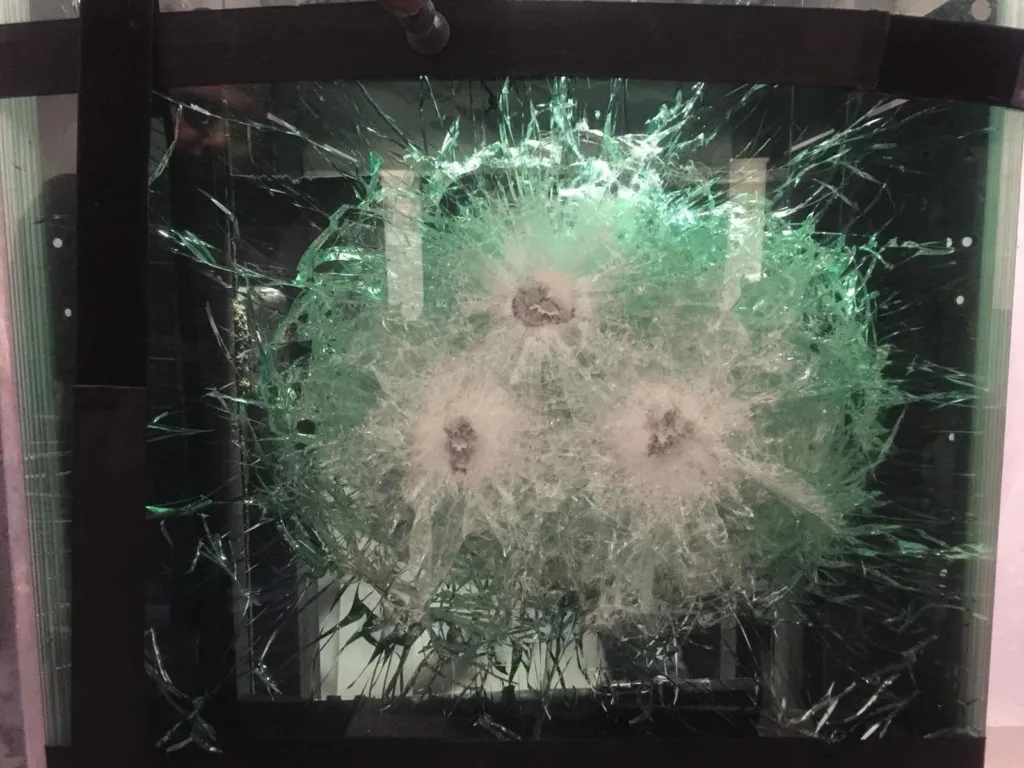
For the BR classes and SG2, three shots are fired at the corners of an equilateral triangle with 120 mm sides. SG1 takes a single shot.
-
A sheet of aluminium foil 0.02 mm thick stands 500 mm behind the sample as a witness. The glass passes if no bullet gets through; the foil then decides the S or NS suffix.
Three closely grouped shots are deliberately harder than one. The second and third rounds land on glass that the first has already cracked and delaminated, so a product that only stops a single bullet does not pass.
BR1 to BR7, SG1 and SG2
The nine classes
| Class | Weapon | Calibre | Bullet type | Bullet mass | Velocity | Strikes |
|---|---|---|---|---|---|---|
| BR1 | Rifle | .22 LR | L/RN | 2.6 g | 360 ± 10 m/s | 3 |
| BR2 | Handgun | 9 mm Luger | FJ/RN/SC | 8.0 g | 400 ± 10 m/s | 3 |
| BR3 | Handgun | .357 Magnum | FJ/CB/SC | 10.2 g | 430 ± 10 m/s | 3 |
| BR4 | Handgun | .44 Rem. Magnum | FJ/FN/SC | 15.6 g | 440 ± 10 m/s | 3 |
| BR5 | Rifle | 5.56 × 45 | FJ/PB/SCP1 | 4.0 g | 950 ± 10 m/s | 3 |
| BR6 | Rifle | 7.62 × 51 | FJ/PB/SC | 9.5 g | 830 ± 10 m/s | 3 |
| BR7 | Rifle | 7.62 × 51 | FJ/PB/HC1 | 9.8 g | 820 ± 10 m/s | 3 |
| SG1 | Shotgun | 12/70 | Solid slug | 31.0 g | 420 ± 20 m/s | 1 |
| SG2 | Shotgun | 12/70 | Solid slug | 31.0 g | 420 ± 20 m/s | 3 |
Reading the ladder
BR1 is the entry level, tested against a .22 rimfire sporting round. BR2 to BR4 are the handgun classes, stepping up from the 9 mm Luger through the .357 Magnum to the .44 Magnum, each heavier and faster than the last. These are the classes most commercial premises ask for.
BR5 to BR7 are the rifle classes, and the jump from BR4 is a big one: velocity roughly doubles. BR5 uses the 5.56 × 45 NATO round with a steel penetrator. BR6 uses the 7.62 × 51 NATO round with a lead core, and BR7 the same calibre with a hardened steel core, which is why BR7 glass is so much thicker than BR6.
The shotgun classes
SG1 and SG2 both use a 12 bore solid slug, a single heavy lead projectile rather than shot. The difference is the number of strikes: one for SG1, three for SG2. Because a slug is slow but very heavy, shotgun resistance does not map neatly onto the BR ladder; a pane rated BR4 has not automatically been proved against SG2, and the reverse is also true.
The standard itself warns that a higher class does not necessarily cover a lower one, because the threats differ in kind rather than just in degree. A rifle round with a steel penetrator and a heavy, slow handgun round attack the glass in different ways. If a building needs to resist both, ask for test evidence for both.
On the certificate
What the bullet codes mean
- L
- Lead bullet, no jacket
- FJ
- Full metal jacket
- RN
- Round nose
- FN
- Flat nose
- CB
- Cone bullet
- PB
- Pointed bullet
- SC
- Soft core (lead)
- SCP1
- Soft core (lead) with a steel penetrator
- HC1
- Hard core, steel of hardness greater than 63 HRC
So a BR4 test round, FJ/FN/SC, is a full metal jacket, flat nosed bullet with a soft lead core; a BR7 round, FJ/PB/HC1, is a full metal jacket, pointed bullet with a hardened steel core. The core is what matters most to the glass: a hard core keeps its shape and keeps drilling where a soft one deforms and spreads its energy.
S and NS
Spall: the suffix that matters to the people behind the glass
S
Spall Allowed
The bullet is stopped, but flying glass fragments (splinters) penetrate the safe side.
NS
No Spall
The bullet is stopped, and the safe side remains smooth with no dangerous glass splinters.
Stopping the bullet is only half the job. When a round hits laminated glass, the layers on the far side can shatter and throw fragments into the room even though the bullet itself never gets through. The witness foil behind the test sample records this: if it is pierced, the class is marked S for spall; if it stays intact, NS for no spall.
No spall glass carries a polycarbonate or similar layer bonded to the protected face, which holds the fragments in. It is the right choice wherever someone sits or stands close behind the glass: a teller position, a reception desk, a guard post. Spall rated glass is thinner and lighter, and can be acceptable where the protected side is unoccupied or set well back. Jaden ballistic glass is supplied in both categories; the thickness table on the ballistic glass page gives the no spall build for each class.
Specifying
Choosing a level
BR2 to BR4
Handgun threats
Banks and cash handling counters, post offices, jewellers and high value retail, pharmacies, late opening premises, police front desks and custody suites. In the United Kingdom the realistic armed threat to most commercial premises is a handgun, which is why BR4 is the most commonly specified class. At Jaden a BR4 no spall pane is 36mm thick, against 23mm for BR2.
BR5 to BR7
Rifle threats
Embassies and consulates, government and military buildings, courts, critical infrastructure control rooms, gatehouses and guard posts on secure sites, and anywhere a security adviser has identified a rifle as a credible threat. The thickness rises steeply: a Jaden BR7 no spall pane is 73mm, and the framing, hardware and floor loading have to be designed around it.
SG1 and SG2
Shotgun threats
Shotguns are the most widely held firearm in the United Kingdom, so a shotgun class is often specified for rural premises, farm offices, gun shops and sites where licensed shotguns are known to be nearby. Where both handgun and shotgun resistance are needed, ask for glass that has been tested to both classes rather than assuming one covers the other.
Ballistic glass is under constant development, including its weight and thickness, so please check current specifications before ordering.
Four things to settle before you specify
- The threat. Which weapon, from where, and whether the attacker is likely to fire more than once. A security consultant, the police Counter Terrorism Security Adviser network or your insurer can help define this.
- The occupied side. If people will be close behind the glass, specify no spall.
- The whole assembly. Frame, fixings, glazing beads and the edge cover of the glass all need to match the class. For a complete window or door, ask for a rating to EN 1522 as well as EN 1063 for the pane.
- Everything else the glass has to do. Thermal performance, solar control, fire resistance, manual attack resistance to EN 356 and blast resistance are separate standards and separate tests. They can be combined in one unit, but each must be specified and evidenced on its own.
Plain speaking
Three things the rating does not mean
- It is not "bullet proof"
- No glass is proof against every bullet. The industry says bullet resistant for a reason: a rating is a statement that a sample stopped a specific round, at a specific speed, a specific number of times. Outside those conditions the rating does not apply.
- It is not the same as a US rating
- The American UL 752 and NIJ standards use different rounds, different shot counts and different pass criteria. A "Level 4" under UL 752 and a BR4 under EN 1063 are not equivalent, and neither should be substituted for the other without the test reports in hand.
- It is not a rating for the building
- The class belongs to the glass. The protection a room actually gets depends on the frame, the wall it sits in, the door beside it and how the glass is fixed. Specify the opening as a whole, and have the installation checked against the manufacturer's glazing details.
Sources
- BS EN 1063:2000, Glass in building. Security glazing. Testing and classification of resistance against bullet attack. British Standards Institution.
- BS EN 1522:1999 and BS EN 1523:1999, Windows, doors, shutters and blinds. Bullet resistance. Requirements and classification; Test method. British Standards Institution.
- BS EN 356:2000, Glass in building. Security glazing. Testing and classification of resistance against manual attack. British Standards Institution.
- Jaden Glass Ltd product data for glass thickness by class. See the ballistic glass page.
Last reviewed 5 November 2026. This guide is general information for specifiers and is not a substitute for a threat assessment or for the test certificates of the product you buy.
Not sure which class you need?
Email info@jadenglass.com or call +44 (0)777 962 8185.