Guide
E, EW and EI fire glass ratings explained
The standard
How fire glass is classified
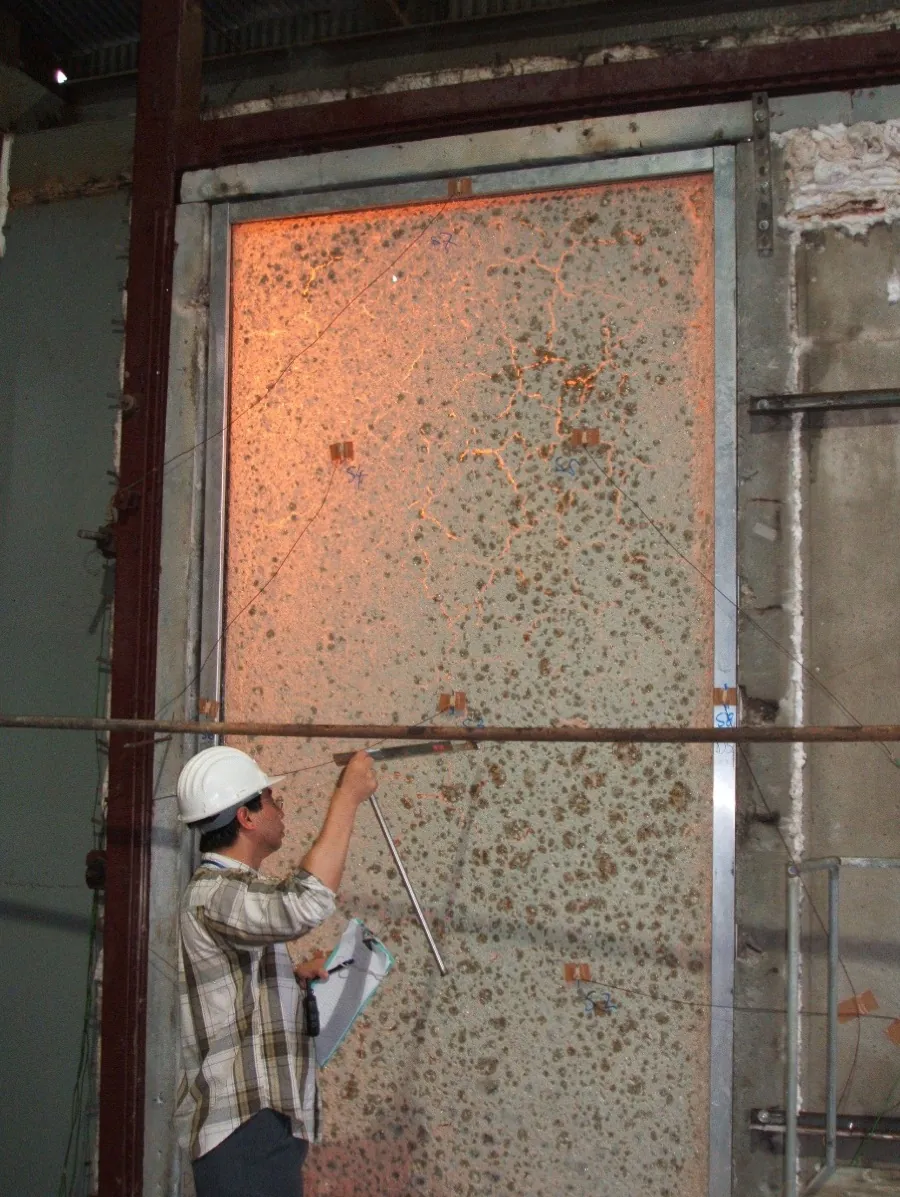
In the UK and across Europe, fire resistance is classified under BS EN 13501-2. A glazed screen, partition, door or window is built at full size, fixed into a furnace wall and heated on one side along a standard time and temperature curve that climbs past 900 °C within the first hour. The test measures how long it keeps doing its job.
The result is written as letters and a number. The letters say which performance criteria were met; the number says for how many minutes they were all met together. Glass is never loadbearing, so the R for loadbearing capacity that applies to walls and floors does not appear. What matters for glazing is three letters: E, W and I.
Each step up the ladder adds a promise. E glass keeps the fire on its own side. EW glass also limits the heat that radiates through it. EI glass also keeps its protected face cool enough to stand beside.
The test
What each letter is tested for
Integrity
The element must not let flames or hot gases through. Testers hold a cotton pad against any crack or opening on the cool side to see whether it ignites, check gaps with gauges, and watch for flaming on the protected face that lasts more than ten seconds.
Radiation
The radiant heat coming off the protected face, measured 1 m away, must stay at or below 15 kW/m². Above that level, heat alone can be hard to bear and can ignite materials nearby.
Insulation
Thermocouples on the protected face record how hot it gets. The average rise must stay within 140 °C, and no single point may rise more than 180 °C, above the starting temperature.
Insulation is the strictest of the three: glass that is still cool on its protected face is, by definition, also holding back radiant heat. That is why an EI rating covers everything an EW rating does, and more.
Side by side
E, EW and EI compared
| Class | Meaning | Holds back | Heat on the protected side | Typical glass |
|---|---|---|---|---|
| E | Integrity | Flames and hot gases | No limit on heat passing through. The protected face can become very hot and radiate strongly. | Fire rated toughened, borosilicate or wired glass. |
| EW | Integrity with limited radiation | Flames and hot gases | Radiant heat measured 1 m from the protected face must stay at or below 15 kW/m². | Laminated or coated fire glass that reflects or absorbs part of the heat. |
| EI | Integrity and insulation | Flames and hot gases | The protected face may rise no more than 140 °C on average, and 180 °C at any point, above its starting temperature. | Multi-layer glass with an intumescent interlayer or gel, such as Jaden EI. |
Reading a rating
EI 60 means the glazing kept both its integrity and its insulation for at least 60 minutes. E 30 means it kept the fire back for 30 minutes but made no promise about heat. The minutes come in set steps, and for glass the ones you will see most are 30, 60, 90 and 120.
The time is a minimum proven in the test, not a prediction for a real fire. It is how buildings are compared and how the regulations say what each part of a building must achieve.
Why the difference matters
Behind E glass, the protected face can get hot enough to burn skin and to set fire to furniture or stored goods placed against it. That is acceptable in some places and not in others. Building regulations restrict where uninsulated glass may be used, particularly in escape routes, which is where EI glass comes in.
An E or EW rating is never a substitute for an EI rating, even if the minutes are the same.
How EI glass works
Clear until it is needed
Two faces of 5 or 6mm glass, with an intumescent liquid gel between. In everyday use the gel is perfectly clear, so the glass looks and performs like a quality laminated pane, with good sound reduction and a Class A impact rating to EN 12600.
In a fire, the pane facing the flames cracks and the gel behind it reacts to the heat, turning into a thick, opaque insulating layer. That layer holds back flames, smoke, hot gases and heat, and keeps the far side cool. Thicker builds, with more layers, hold out for longer: 30, 60, 90 or 120 minutes.
Specifying
The rating belongs to the whole glazed system
-
The frame
Steel, timber or aluminium framing tested with that glass, at that rating.
-
Seals and beads
The intumescent seals, gaskets and glazing beads used in the test.
-
The size
Panes no larger than the sizes the test evidence covers.
-
The fixing
Installation to the system manufacturer's details, by people who know them.
Ask for the classification report covering the glass in the framing system you intend to use. If any part is changed, the rating may no longer apply.
Jaden EI glass
EI 30 to EI 120, inside and out
Interior EI Glass
| Product | Class | Thickness | Light transmission | Sound reduction (Rw dB) |
|---|---|---|---|---|
| Jaden EI 30-IN | EI-30 | 22 mm | 87% | 5.6 |
| Jaden EI 60-IN | EI-60 | 28 mm | 86% | 5.6 |
| Jaden EI 90-IN | EI-90 | 34 mm | 86% | 5.6 |
| Jaden EI 120-IN | EI-120 | 50 mm | 86% | 5.6 |
Exterior EI Glass
| Product | Class | Thickness | Light transmission | U-value (W/m²K) |
|---|---|---|---|---|
| Jaden EI 30-EX ISO | EI-30 | 38 mm | 74% | 1.4 |
| Jaden EI 60-EX ISO | EI-60 | 44 mm | 73% | 1.4 |
| Jaden EI 90-EX ISO | EI-90 | 50 mm | 73% | 1.4 |
| Jaden EI 120-EX ISO | EI-120 | 66 mm | 73% | 1.4 |
Two faces of 5 or 6mm glass, with an intumescent liquid gel between, plus an additional 12mm spacer bar, with a 6mm Low E or solar control outer.
Full specifications, including weights, are on the fire resistant glass page.
Common questions
Fire glass ratings, answered
- What does EI 60 mean?
- It means the glazed element kept its integrity (E) and its insulation (I) for at least 60 minutes in a standard fire test. The number is the time in minutes; the letters are what it achieved for that whole time.
- What is the difference between integrity and insulation?
- Integrity is about the barrier staying whole: no flames, no hot gases, no gaps. Insulation is about heat: the side away from the fire stays cool enough that people can pass close to it and materials against it do not catch light.
- Is EI glass better than E or EW glass?
- It does more, so it is the right choice wherever people need to pass close to the glass during a fire, such as escape routes. E and EW glass are lighter and cheaper, and are used where the regulations and the fire strategy allow uninsulated glazing.
- Is fire resistant glass the same as toughened glass?
- No. Ordinary toughened glass is a safety glass, not a fire glass, and it can fail quickly in a fire. Fire resistant glass is tested and classified under BS EN 13501-2 for a stated number of minutes.
- Does the rating belong to the glass alone?
- No. Fire resistance is tested on a complete glazed element: glass, frame, seals and fixings, at a stated size. The classification only applies to the glass when it is installed in a system and at a size covered by the test evidence.
- Can EI glass be used on the outside of a building?
- Yes. Exterior EI units add a cavity and an outer pane of low E or solar control glass, so the facade gets fire resistance and thermal performance together. Jaden supplies these as the EX ISO range from EI 30 to EI 120.
Sources
- BS EN 13501-2, Fire classification of construction products and building elements. Classification using data from fire resistance tests, excluding ventilation services. British Standards Institution.
- BS EN 1363-1, Fire resistance tests. General requirements. British Standards Institution.
- BS EN 1364-1, Fire resistance tests for non-loadbearing elements. Walls. British Standards Institution.
- BS EN 1634-1, Fire resistance and smoke control tests for door and shutter assemblies, openable windows and elements of building hardware. British Standards Institution.
- Jaden Glass Ltd product data for EI glass construction and performance. See the fire resistant glass page.
Last reviewed 3 November 2026. This guide is general information and is not a substitute for a fire strategy, the building regulations that apply to your project, or the classification report for the system you install.
Need EI fire glass for a project?
Email info@jadenglass.com or call +44 (0)777 962 8185.